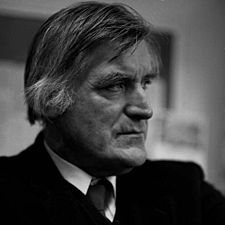
Showing posts with label Ted Hughes. Show all posts

Wednesday, 6 October 2010

Hughes on Plath's final hours...


It is one of the most famous literary relationships, and now a poem in which Ted Hughes describes the night his first wife Sylvia Plath took her own life in 1963, has been published for the first time. Beginning with 'What happened that night? Your final night', 'Last Letter' details the events of Plath's final weekend. The poem was discovered by the guest editor of the 'New Statesman' Melvyn Bragg, who was directed to the piece by Hughes' second wife Carol.

Thursday, 15 April 2010

Stained Ted Hughes journal found...


The British Library has acquired a rare copy of Ted Hughes's journal. 'St. Botolph's Review', established by the Poet Laureate with friends at Cambridge University in 1956, is often cited as launching his career, and features some of his earliest works. The particular copy, stained and containing several handwritten notes by Hughes, is one of only three in UK public institutions and was obtained from his widow Carol. Curator Helen Broderick said; 'I hope [this will] lead to further research into his life and development as a poet and writer'.

Tuesday, 23 March 2010

Ted Hughes to enter Poets' Corner...


After much debate, wrangling and controversy, it has been announced that Ted Hughes will join those honoured in Poets' Corner. Westminster Abbey commerates literary greats from Shakespeare to Shelley, from the Brontes to Blake, with Hughes set to become the latest name. Although his ashes will not be re-interred, the former Poet Laureate's achievements, which include such works as 'Crow' and 'Birthday Letters', will be marked by a plaque from early next year.

However, the decision has not been without its protests. Critics cite the dark subject matter of much of his poetry, and the suicide of wife Sylvia Path and mistress Assia Wevill as reason enough to not see him sit aside perhaps slightly 'cleaner' writers. Yet you only have to examine each writer within their context to discover that few were what you may call 'ideal'. Perhaps it is only the rawness of Plath's death that still hangs over many. Whatever the reason, in centuries to come, all that will matter is that Hughes will be seated alongside Chaucer and Dickens, in the halls of literary greats.

Tuesday, 1 December 2009

Religious approval for Hughes?...


Poet Ted Hughes may be honoured with a plaque in Westminster Abbey's Poets' Corner. The Dean of Westminster said that he had received a number of letters persuading him to the cause; a cause supported by fellow poets Seamus Heaney and Andrew Motion. A former Poet Laureate, Hughes is best known for his marriage to Sylvia Plath, whose subsequent suicide in 1963 shocked the literary world. If selected for a plaque, Hughes would be the first since the man he succeeded as Poet Laureate in 1984, John Betjeman; and would join the likes of Thomas Hardy, William Blake and T.S. Eliot. Hughes died in 1998, and is described by Heaney as 'one of the vital presences in 20th century poetry.'

Tuesday, 27 October 2009

On this day...


The American poet and prose writer Sylvia Plath was born, in 1932. Born in Massachusetts, she attended Cambridge University, and it was there that she met and married poet Ted Hughes, a later Poet Laureate. She is known as one of the main contributors to the genre of confessional poetry - in which the poem shares intimate details surrounding the poet's life. Although famous for her poetry, perhaps her best known work is in prose - the semi-autobiographical 'The Bell Jar' written under the pseudonym Victoria Lucas. After numerous suicide attempts, many initiated by her husband's affair, she finally succeeded in February 1963; dying at the age of 30.