'The man who does not read good books has no advantage over the man who cannot read them'
Mark Twain
Mark Twain
Showing posts with label on this day. Show all posts
Saturday, 13 October 2012
The Conscientious Objector...
On this day...American poet Robert Lowell is condemned to prison for evading the draft in 1943. Considered one of the founders of the confessional movement, Lowell would go on to win the Pulitzer Prize, National Book Award and serve as the Poet Laureate Consultant in Poetry to the Library of Congress - yet as a 26 year-old his words only seemed to get him into trouble.
Writing of his decision not to join WWII, Lowell said in his letter addressed to then President Roosevelt: 'Dear Mr President: I very much regret that I must refuse the opportunity you offer me in your communication of August 6, 1943 for service in the Armed Force'. Such a response earned Lowell a year long sentence served first in New York and then Connecticut - an experience recalled in his poem 'Memories of West Street and Lepke' from his collection 'Life Studies'.
Seemingly an ideologically headstrong cohort, Lowell was not the first, and will surely not be the last writer to suffer for their personal convictions.
Tuesday, 18 September 2012
The Apprentice...
On this day...Aldous Huxley was hired as a schoolmaster at Eton in 1917. After deterioring eyesight had put pay to a career in medicine, the future author of 'Brave New World', returned to his alma mater to teach French. Yet it is one of his students that is arguably more noteworthy. Eric Blair, who would later use the pen name George Orwell, was impressed with his teacher's mastery of language despite Huxley being, by accounts, a poor educator.
This is only one of many relationships forged between authors throughout history. Famous pairings include:
- C.S. Lewis & J. R. R. Tolkein
- Bram Stoker & Oscar Wilde (Stoker married Wilde's fiance)
- F. Scott Fitzgerald & Ernest Hemingway
Saturday, 2 June 2012
The Charmer...

On this day...The charismatic author and poet Vita Sackville-West died in 1962 at the age of 70. Born into an aristocratic family, Vita seemingly fulfilled parental expectations through her marriage to career politician Harld George Nicholson. Yet this perfectly ordinary facade was somewhat thrust away by an altogether more exotic lifestyle. Although she and her husband enjoyed a stated closeness, it was understood to be an open marraige, and one which Vita strayed from through numerous partners, including, most famously, the novelist and pillar of modernism Virginia Woolf. Indeed, it was as a result of this affair that Woolf wrote Orlando, described by Sackville-West's son as 'the longest and most charming love-letter in literature'.
However, it should not be assumed that Sackville-West's only contributionto literature was a liason with one of its most profound assets. The author of The Edwardians, (a critique of aristocratic society) and All Passions Spent, Sackville-West also became the only writer to ever win the Hawthornden Prize twice for her poetry and wrote biographies of both Joan of Arc and Aphra Behn. These achievements were crowned in 1947 as she was made a Companion of Honour for her services to literature.
Monday, 16 January 2012
The Stickler for the Rules...

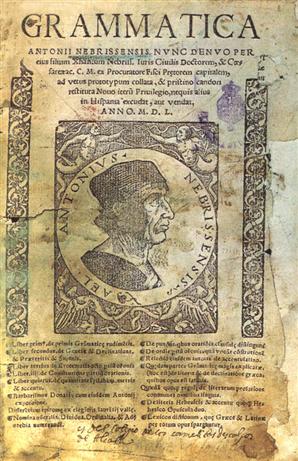
On this day...Antonio de Nebrija presented the first Spanish grammar book to Queen Isabella I in 1492. Since compared to names such as Erasmus, de Nebrija, who later latinized his name to 'Aelius Antonius Nebrissensis', had dedicated his life to furthering classical education is his native land.
His 'Gramatica de la lengua castellena', which was the first book to study the rules of a Western European language other than Latin, was split into four books: Orthography, Prosody and syllables, Etymology and diction, and Syntax. A fifth book aided those learning Castillian as a foreign language.
Upon presenting the book to the queen, she is said to have asked, 'Why would I want a work like this? I already know the language.' Nebrija reportedly answered, 'Majesty, the language is the instrument of the empire'
Wednesday, 9 November 2011
The Tragic Welshman...

On this day...Welsh poet Dylan Thomas died in 1953 at the age of 39. The child of an English master and seamstress, Thomas was born in Swansea only months after the outbreak of the First World War. Despite his Welsh heritage, Thomas was brought up to speak only English, and continued to use the anglicised form of his name throughout his life. An ill child, and undistinguished student, Thomas spent his time keeping poetry notebooks and between the years of 1930 and 1934, accumulated over 200 entries which would later form over half of his published works.
Sadly it is Thomas' blighted personal life that seems to so often overshadow the remarkableness of his poetry. Having married a dancer in 1937, Thomas was considered to weak to serve in World War Two, instead writing scripts for the government. Indeed the immediate post war period was one of literary success, with the emergence two of his best known works, 'Deaths and Entrances', and 1953 radio play 'Under the Milkwood'. However, by now a committed alcoholic, Thomas soon took a turn for the worst. Whilst in New York to take part in his play, Thomas suffered black outs, turned blue and slipped into a coma, before finally dying of pneumonia. Despite his tragic and early death, Thomas is still celebrated as one of the nation's best loved poets.
Wednesday, 26 October 2011
The Literary King...
On this day...English monarch Alfred the Great died in 899 at the approximate age of 50. The only English royal to be attributed with such an epithet, Alfred is renowned for his miltary achievements, not least the protection of his Anglo-Saxon kingdom from the Vikings. Yet what is perhaps less well known about the youngest son of Æthelwulf of Wessex, is his penchant for learning. Inspired by Charlemange, Alfred created a court school, not only to educate his own children, but also, countering the perception of aristocratic snobbery, to educate those of lesser birth who showed intellectual potential. Indeed, after only a short time, 'they were seen to be devoted and intelligent students of the liberal arts'.
If the younger generation were embarking on a process of learning, it also made sense for Alfred to cement that of the elder, and so he ensured that literacy became a requirement for those holding a position of authority, especially in religious capacities. The king chose to lead this charge on education himself, beginning a Alfredian programme of translation of books into English that he deemed 'most necessary for all men to know'. These works included Gregory the Great's 'Pastoral Care', Boethius's 'Consolation of Philosophy', St. Augustine's 'Soliloquies', and the first fifty psalms of the Psalter.
Tuesday, 18 October 2011
The Class of 1386...

On this day...The University of Heidelburg was officially opened in 1386. The oldest univeristy in Germany, and only the third established in the Holy Roman Empire, Heidelburg has many things to boast of. Not least is its alumni, whose numbers include 30 Nobel Laureates, German Chancellors, and even a Pope. However, for those of a literary persuasion, there are also several notable associations. Perhaps the most decorated is Nobel Laureate Carl Spittler who was rewarded 'in special appreciation of his epic, "Olympian Spring"'.
Yet despite his success amongst critics and academics, Spittler is by no means the best known inhabitant of the medieval walls. Mark Twain, who visited the univeristy as part of his European tour in 1878, detailed his impression in the travelogue 'A Tramp Abroad', humorously depicting a student body of aristocratic dandies. Such was the popularity of the American writer, that a US Army base in the city now bears his name. The university also plays fictional host to W. Somerset Maugham's Philip Carey in his novel 'Of Human Bondage' and, perhaps more famously, appears on screen in the Oscar winning adaptation of Bernard Schlink's 'The Reader'.
Tuesday, 19 July 2011
The Romancer...

On this day...Famous Italian poet and 'Father of Humanism' Francesco Petrarca, or Petrarch, died in 1374 at the age of 69. Born in Tuscany, Petrarch spent much of his early childhood in Florence before leaving with his family to Avignon to follow the flourishing papacy of Pope Clement V. There, much against his wishes he was schooled in the practice of law - a profession he could only escape from upon the death of his parents. Instead he pursued his love of classical literature, creating his own Latin epic 'Africa', and his disdain for the ignorance of the intervening centuries led Petrarch to be credited with creating the concept of the 'Dark Ages'.
Although he fulfilled many roles throughout the rest of his life - scholar, diplomat, priest - Petrarch is best known for his poetry, in particular, that devoted to Laura. The identity of the woman is unknown, yet she has become famous world over as the original Petrarchan ideal, which writers such as Sidney and Shakespeare have since incorporated in their own works. 'Il Canzoniere', or 'The Songbook', mainly written in sonnet form, alongside 'Secretum' and 'Itinerarium', Petrarch's guide to the Holy Land, have ensured his place among the greatest and most influential of the world's writers.
Monday, 11 July 2011
The Scottish Adventure ...

On this day...English poet John Keats visited the home of another famous composer of verse, Robert Burns in 1818. During a summer walking tour in the North Country, whilst traversing 20 or 30 miles a day, Keats came to the family home of the Scottish Bard in Alloway.
The 'Ploughman Poet', who had died 24 years previously, has since been lauded as a founder of the Romantic movement, and influenced not only Keats himself, but also his contemporaries, such as Percy Bysshe Shelley and William Wordsworth. It was here that Keats composed his sonnet, 'Written in the Cottage Where Burns Was Born' - a poem most notable for its premonitory first line, 'this mortal body of a thousand days'. Keats died 43 days short of this number.
Thursday, 7 July 2011
The Class Clown...

On this day...Irish playwright, poet and politician Richard Brinsley Sheridan died in 1816, at the age of 64. Born in Dublin to parents both active in the theatre business, Sheridan moved to England at the age of seven and attended the independent Harrow School. The most significant event of his early life however, was not of literary importance, rather, it was two duels fought against Captain Matthews, who had defamed Sheridan's wife-to-be in a newspaper article.
Having barely escaped with his life, Sheridan set up a house in London and began writing for the stage, opening with the play, 'The Rivals'. Although a failure on its first performance, a change of actor ensured that its second was an immediate success, and following another profitable composition, 'The Duenna', Sheridan was able to buy complete ownership of the Drury Lane Theatre. It was there that some of his most famous plays, such as 'The School for Scandal' and 'The Critic', made their debut. At the same time, Sheridan was vigourously engaging in parliamentary work, yet things cam to a head in 1809, when his theatre burnt down. Three years later, he failed to gain re-election after 32 years, and he died in poverty after contracting an illness. Sheridan is buried in Poets' Corner.
Saturday, 25 June 2011
The Mouse King...

On this day...German author Ernst Theodor Wilhelm Hoffmann, better known as simply E. T. A. Hoffmann, died in 1822 at the age of 46. His father was a successful barrister, yet by Hoffmann's second birthday, his parents had separated and he was later to regret his paternal estrangement. Instead, he lived with his mother in Königsberg and was educated by his two aunts and uncle until his enrollment in a local school. Despite displaying a great talent for the arts from a young age, he was held back by his rural setting and took it upon himself to read Göthe and Rosseau, as well as attending lectures by Kant.
The next few years were spent travelling around Prussia in various capacities, trying his hand both at composing and drawing, before being exiled due to some controversial caricatures. A victim of the Napoleonic wars, Hoffmann was forced to return to Berlin, now married, and it was here that his literary career began in earnest, finding success with 'Ritter Gluck'. Yet finding daily work was becoming increasingly difficult, and with failing health, mainly attributed to alcohol abuse and syphilis, he left theatre management to become a jurist. It was to be his last job. Remembered as a pioneer of the fantasy genre, Hoffmann is best known for his work 'The Nutcracker and the Mouse King', on which the ballet is based, and his influence on later authors such as Edgar Allan Poe.
Wednesday, 16 March 2011
The fugitive...

On this day...Lithuanian book smuggler Jurgis Bielinis was born in 1846. 1864 heralded the start of the Lithuanian press ban, during which all Lithuanian language books published in the Latin alphabet were forbidden by the ruling Russian Empire. Tsarist authorities hoped that this measure, part of a larger Russification plan, would decrease Polish influence on Lithuanians and would return them to what were considered their ancient historical ties with Russia.
However, Bielinis showed resistance, taking it upon himself to form the Knygnešiai society - the largest contemporary book smuggling organisation. Nicknamed 'The King of the Book Carriers', Bielinis was actively sought by the authorities, who promised a large monetary reward for his capture after he had escaped their guards at least five times. During the 31 years of his activity, it is estimated that he and his society illegally brought about half of all Lithuanian books from East Prussia into the Lithuanian mainland during the entire press ban. Bielinis died in 1918 at the age of 71.
Tuesday, 15 March 2011
The Philanderer...

On this day...German writer Paul Johann Ludwig von Heyse was born in 1830. The son of Felix Mendelssohn's tutor, and a Prussian court jeweller descendant, Heyse was born into a family already heavily connected with the artistic world. Thus he soon befriended names such as Theodor Fontane and Emanuel Geibel, joining the literary group Tunnel ĂĽber der Spree, before publishing his first poem, 'FrĂĽhlingsanfang', in 1848. Although settled on becoming a writer, Heyse's hopes were initially short-lived, as he was discovered to have been conducting an affair with the wife of a university professor and was sent back to Berlin in disgrace.
Yet it was in Munich that his literary revival was secured. Granted an audience with the King of Bavaria, Heyse presented his verse tales, 'Hemen', and preceeded to become known as one of the Nordlichten, establishing his own literary society, Die Krokodile. He continued to write prolifically and his work was recognised in 1910, when he received the Nobel Prize for Literature as 'a tribute to the consummate artistry, permeated with idealism, which he has demonstrated during his long productive career as a lyric poet, dramatist, novelist and writer of world-renowned short stories'. Hysee died in 1914, at the age of 84.
Monday, 14 March 2011
The Anonymous Writer...

On this day...English author Thomas Malory died in 1471, at the age of approximately 66. The compiler of 'Le Morte d'Arthur', Malory translated the Arthurian romance tales of the King, Guinevere and Lancelot from French prose into eight books of Middle English verse, providing the basis for later literary works such as T.H. White's 'The Once and Future King', and Tennyson's 'The Idylls of the King'. Yet despite a lasting literary legacy, much uncertainty surrounds the man himself.
At least six Thomas Malorys were alive at the time of the books writing, and from those, three main theories have emerged as to the identity of the author. Firstly, it was proposed by John Bale, that Malory was Welsh, hailing from Maloria and related to the poet Edward Rhys Maelor. The second alias is that of Thomas Malory of Papworth St. Agnes - a respected, yet average, country gentlemen. Yet it is to the turn that most scholars look, Sir Thomas Malory of Newbold Revel. A soldier and politician in the early years of his life, Sir Thomas turned to thievery, rape and kidnapping, serving time in both Marshalsea and Newgate Prisons. The most popular claimant, it is this Thomas Malory who died 540 years ago.
Labels:
Alfred Lord Tennyson,
King Arthur,
on this day,
Thomas Malory
Tuesday, 21 December 2010
The Family Man...

On this day...Romantic poet William Wordsworth and his sister Dorothy moved into Dove Cottage in 1799. The previous autumn had seen the pair in Germany, along with fellow poet Samuel Taylor Coleridge. One of his many trips to Europe, Wordsworth was reportedly homesick and thus it was in 1799 that he moved back to the Lake District - the region in which he grew up. His work at this time comprised of 'The Lucy Poems', a series of five poems later included in his 'Lyrical Ballads' collection. Living near Coleridge and Robert Southey, the trio became collectively known as the 'Lake Poets'.
Monday, 20 December 2010
The Collaborator...
On this day...English playwright John Fletcher was baptised in 1579. The son of a cleric, who later became chaplain to Queen Elizabeth, Fletcher was a child prodigy and entered Cambridge University at the age of 11. Despite this start, little is known of Fletcher throughout his education until he reappeared as a writer for the Children of the Queen's Revels, and a performer at Blackfriars Theatre.
Fletcher's best known works are as a collaborator, especially with Francis Beaumont, such as 'The Maid's Tragedy' and 'Philaster'. So close was their relationship, that they were purported to live in the same house, share each other's clothes and even had 'one wench in the house between them'. Their partnership ended with Beaumont's marriage in 1613, and Fletcher's illness in the same year. Subsequently he became a more firm fixture with the King's Men, collaborating with Shakespeare on 'Henry VIII' and 'The Two Noble Kinsmen'. Fletcher continued to write for the company as a solo playwright after Shakespeare's death, returning to collaboration shortly before his own. One of the most important dramatists of the era, Fletcher died in 1625, at the age of 45.
Friday, 17 December 2010
The Waffler...

On this day...Leo Tolstoy's 'War and Peace' was sold by the 'Moscow News' in 1867. The now famous literary work was listed thus; 'War and Peace. By Count Leo Nikolayevich Tolstoy. Four volumes (80 sheets). Price: 7 rubles. Weight parcel post: 5 pounds. The first three volumes delivered with a coupon for the fourth'. It seems strange the the novel was so lightly offloaded, considering that that the book was 'five years of unremitting and singleminded labour,' something 'not simply imagined by [Tolstoy] but torn out of [his] cringing entrails'. However, these efforts were soon rewarded when the novel became known as Tolstoy's masterpiece.
Monday, 13 December 2010
The Master Criminal...

On this day...American crime fiction writer Kenneth Millar, better known by pseudonym Ross Macdonald, was born in 1915. By the time he was 16, having been abandoned by his father, and moved around the country to stay with various relatives, Macdonald had gained enough experience of broken relationships and domestic troubles for them to become a prominent theme in his later writings.
Tragedy also struck later in his life, when Macdonald sadly lost his daughter Linda in 1970. Excluding a brief period in which he was involved in the war as a naval communications officer, Macdonald produced a steady stream of great novels, including his famous Lew Archer series. Inspired by F. Scott Fitzgerald among others, he is said to be the heir to Dashiell Hammett and Raymond Chandler as the master of the American hardboiled mysteries.
Monday, 6 December 2010
The Voice...

On this day...American inventor Thomas Edison recorded one of the earliest recordings of the human voice in 1877. Known as the 'Wizard of Menlo Park' for his phonograph invention, Edison used tinfoil and a grooved cylinder to record poor quality sounds. The recordings could only be played several times, and the phonograph was redesigned a decade later by Alexander Graham Bell using wax-coated cardboard cylinders. Yet the occasion of Edison's remarkable breakthrough in 1877, was marked by him reciting 'Mary Had a Little Lamb', which can be heard here.
Although this has obviously had an incredible impact on modern society, the Poetry Archive is one small example of how it has furthered literature. Set up by former Poet Laureate Andrew Motion, the site contains recordings of poets reading their own work, including names such as Alfred Lord Tennyson and Seamus Heaney. Motion created it with the thought that any lover of literature is able to gain deeper insight , levels of understanding, and enjoyment by listening to a poem in the voice in which it was composed.
Thursday, 2 December 2010
The Horseman...

On this day...Romantic poet Samuel Taylor Coleridge joined the cavalry in 1793. Using the false name, 'Silas Tomkyn Comberbache', Coleridge had quit his university education to enlist in the Royal Dragoons, with speculation suggesting it was either due to rising debt, or rejection from a girl that he loved.
Thought to subsequently suffer from about of severe depression, he was discharged with the help of his brothers on the grounds of 'insanity'. He was readmitted to Cambridge, and it was there that his great literary career began to blossom.
Subscribe to:
Posts (Atom)