Friday, 20 November 2009

On this day...


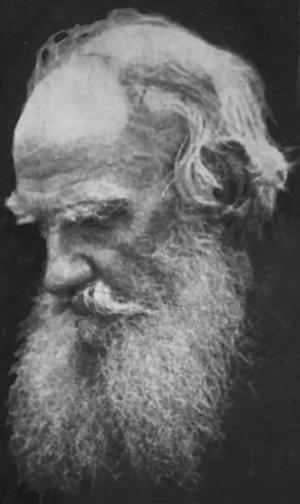
Russian realist writer Leo Tolstoy, died in 1910 at the age of 82. Descended from Russian aristocracy, he was described at university as 'both unable and unwilling to learn', and he left, amounting huge gambling debts and evenutally joining the army. Tolstoy's transformation into the literary talent he is recognised as today, occured during a trip to Europe, where he met Victor Hugo, author of 'Les Miserables'. Inspired, Tolstoy went on to produce some of the best known works of Russian literature, 'War and Peace', and 'Anna Karenina'; which he used to convey a realistic perspective of the Russian society in which he lived. He was praised by his contemporaries; Chekhov saying of him, 'What he does, serves to justify all the hopes and aspirations invested in literature.' Yet Tolstoy himself proved a harsh critic, telling Chekhov, 'I think Shakespeare's plays are terrible, but yours are even worse'. Indeed, Shakespeare was widely criticised by Tolstoy throughout his lifetime, Tolstoy confessing to feel 'an irrestitible repulsion and tedium' while reading his works. Alongside fellow writers Dostoyevsky, Chekhov and Pushkin, Tolstoy is considered part of Russia's golden age of literature.

Thursday, 19 November 2009

Success from beyond the grave...


Yesterday, saw author Neil Gaiman continue his huge success with new novel 'The Graveyard Book'. Already having won America's Newbery Medal, Locus Young Adult Award and Hugo Best Novel Prize, Gaiman was awarded the Booktrust Teenage Prize at a ceremony in London; and further achievement may be just around the corner, owing to his nomination for both the Carnegie Medal and World Fantasy Award. Citing both Ruyard Kipling and P.L. Travers, of 'The Jungle Books' and 'Mary Poppins' fame respectively, as inspirations, Gaiman said that he was both 'thrilled and surprised' by receiving the award, whose £2,500 prize money he will spend on 'cool art'. The judges said of Gaiman's novel that it 'won the hearts of all the judges, young and old...the writing is gentle, fluid and humorous, and fundamentally uplifting'. Gaiman's next work is set to be a 'part-fiction, part-non-fiction travelogue and real life history', set in China.

On this day...


English playwright and poet Thomas Shadwell died in 1692, at the age of 50. In relative terms a literary success, Shadwell was awarded the title of Poet Laureate in 1689, succeeding contemporary John Dryden. Yet it is for his relationship with Dryden, mainly conveyed through text, that he is best remembered; the two swapping some three satirical pieces each, about the other. It was Dryden who came out on top; the protagonist of his work 'Mac Flecknoe', the King of Dullness, giving his crown to Shadwell, who is described as 'confirm'd in full stupidity'. While many of their debates took to a political or religious line, both diametrically opposed on those issues, the pair were also known to contemplate more intellectual ideas, such as whether Ben Jonson or Shakespeare were a better playwright. The best works of the man who 'enjoyed a popularity in his own day which is not easily explicable in ours', are play 'Epsom Wells', and poem 'Dear Pretty Youth'.

Wednesday, 18 November 2009

First Book Award...


The shortlist for the Guardian First Book Award was announced last month. Founded in 1999, the prize is awarded to first time writers in any genre, and carries with it £10,000 and an advertising package in the Guardian and Observer. The most prominent name on the shortlist, is Samantha Harvey, and her novel 'The Wilderness'; the work has already won the £25,000 Betty Trask Award and been nominated for both the Orange and Booker Prizes. Another name on the shortlist is that of Reif Larsen, whose novel 'The Selected Works of TS Spivet', was bought by Penguin Books for almost $1 million, after a ten way bidding war by publishers. Also included are of work of non-fiction and a collection of short stories. The full shortlist can be found here. The winner will be announced on December 2nd.

On this day...


Marcel Proust, French novelist and essayist, died in 1922. Born in 1871, just after the Franco-Prussian War, much of Proust's childhood corresponded with the rise of France's Third Republic; a theme that later found its way into many of his works. He wrote from an early age, contributing to numerous journals while he was still at school and even founding his own literary review, 'Le Banquet'. Fascinated by English social critic contemporary John Ruskin, Proust began to translate Ruskin's works into French; yet his poor command of English hampered him, and instead Proust used him to enhance his own theories on art, and the role of art within society. His most famous work, 'In Search of Lost Time', often considered the definitive modernist novel, incorporates themes of time, space and memory. He died in 1922, aged 51.

Tuesday, 17 November 2009

From concubines to communism...


Today saw the winner of the Man Asian Literary Prize announced. The prize, awarded to an Asian novel not yet published in English, was set up in 2007, and offers a monetary incentive of £10,000. Su Tong, who has been commended for his novel, 'The Boat Redemption', has stated that he is usually 'more famous for not winning prizes', but judges declared his book to have 'immense charm'. Based around the story of a disgraced Communist party official, it had the potential for controversy, yet was instead cited as 'a political fable with an edge which is both comic and tragic'. Previously to this, Su's most famous work was 'Wives and Concubines', a novel which inspired the 1991 film 'Raise the Red Lantern'.

On this day...


Queen Mary I, died in 1558; leading to the ascension of Queen Elizabeth I to the throne, and sparking of one of the greatest periods of literature in history. The Elizabethan era is, of couse, best known for dramatist and poet William Shakespeare. 25 of his 37 plays were purportedly performed during Elizabeth's reign, and she herself was known to be an admirer; the Lord Chamberlain's Men said to have performed over thirty-two times at court. Yet Shakespeare was not the only influential playwright of the era; contempories Ben Jonson and Christopher Marlowe are equally renowned, the latter possibly even more so in his lifetime. Elizabethan literature also widely contributed to the field of poetry, not least with the reinvention of the sonnet by Shakespeare, but also through the works of Philip Sidney and the first writings of John Donne; Donne was voted this year, the nation's second favourite poet. Other figures of the era include; Thomas Kyd, John Webster and Thomas Middleton. Much of this prolific writing continued into the Jacobean period.

Monday, 16 November 2009

Doctor Who?...


It has been announced that next year will see the publication of a new Doctor Who novel. Michael Moorcock, a science fiction writer famed for the 'Elric of Melnibone' series, stated that he had been approached by BBC books to write a novel available for publication next Christmas. However, many fans have been critical, believing that, as someone not associated with the show, Moorcock's interpretation will not fit in with their own view ane perhaps is not a big enough name. Yet Moorcock is quick to counter this, declaring himself to have watched the show for years and saying; 'since the Tom Baker series, a lot of my ideas crept into the stories and so in many ways I'll be writing a story which already echoes my own work.' This announcement follows the airing of a second Doctor Who special this year, and so is likely to only increase the fanaticism that surrounds the series; which is set to introduce new Doctor Matt Smith next year.

On this day...


Nigerian novelist, poet and social critic Chinua Achebe, was born in 1930. Starting his career at the Nigerian Broadcasting Service, Achebe soon became captivated by world religions and cultures, especially those of a traditional African nature. This fascination soon led to a literary career, writing his first, and still probably best known, work 'Things Fall Apart'in the late 1950s. He continued to write through the next few decades, yet soon found a niche in the political scene. 1967 saw the province Biafra attempting to gain independence from Nigeria; a move which Achebe fully supported, even serving as a ambassador of the new nation. Yet by 1970, it had been taken back by the government, leaving Achebe ostracised from politics due to the corruption he felt to be so prevalent. He moved to the U.S, delivering lectures; including one in which he described Joseph Conrad as a 'racist'. His best known poetical work is 'Vultures', and he continues to speak passionately on African issues at the prestigious Ivy League Brown University.

Sunday, 15 November 2009

GCSE makes you better than Hemingway...


A proposed new computerised marking system for A-Level English exams, has failed some of the most famous writers and orators that ever lived. The system was discussed last week at the Westminster Education Forum; a meeting which included heads of exam boards and the Charted Institute of Educational Assessors. It is thought that online marking will soon be introduced, with computers already marking some multiple choice GCSE papers and trials taking place for those which are essay based. Yet the system has encountered some flaws. Among those singled out for criticism, were Ernest Hemingway, for his 'lack of care in style of writing'; William Golding, for his 'innacurate and erratic sentance structure'; and Anthony Burgess for being 'incomprehensible'. Surely, if the 'classics' would have failed, it signifies against the popular belief, that A-Levels are actually getting harder? Or, at least, that it's more about a marking system than writing?

On this day...


James Boswell, the Scottish diarist, set out for London in 1762. During the eight and a half month stay that followed, Boswell wrote his 'London Journal'; he documented each detail of the city, in which he stated that 'we may be in some degree whatever character we choose.' The most significant event recorded was his meeting with prolific essayist, poet and author Samuel Johnson; an event which led to the creation of Boswell's most famous work, 'The Life of Samuel Johnson'. Often said to be the greatest biography ever written, it earned Boswell the reputation he had long sought for; indeed the word 'Boswellian' has evolved into the English language, meaning one who studiously records the deeds of others. Many of Boswell's works were not discovered until the 1920s; over 8,000 pages of manuscript including records of meetings with playwright Oliver Goldsmith and philosopher Edmund Burke. Boswell died in 1975, aged 54.

Saturday, 14 November 2009

Murder, monsters and Austen?...


The gothic genre, is one which has had both popularity and longevity, and boasts many of today's best known novels. A combination of horror and romance, it is thought to have been started by Horace Walpole's 'The Castle of Otranto' in 1764 and has grown prolifically since, with key eras of notable contribution. Coleridge's 'Christabel' and 'The Rime of the Ancient Mariner' as well as Shelley's 'Frankenstein' are all examples of gothic literature from the Romantic period; yet arguably, it was the Victorian era which proved the most productive for the genre. Titles such as Stevenson's 'Dr. Jekyll and Mr. Hyde', Wilde's 'The Picture if Dorian Gray', and Stoker's 'Dracula' all found their conception in Victorian society; America having its own star in Edgar Allan Poe. Despite it huge popularity, gothic fiction has also produced numerous satires, the famous of which is Austen's 'Northanger Abbey'. A quiz on the gothic genre can be found here

On this day...


Herman Melville's 'Moby-Dick' was published in New York in 1851. It had been published in Britain one month previous, entitled 'The Whale', yet had contained an incomplete and rearrranged ending, rendering a hostile reception on its American publication. Contemporary critics said of it; 'The idea of a connected and collected story has obviously visited and abandoned its writer again and again in the course of composition.' Maintaining only a fragile readership in his lifetime, Melville's death in 1891 signalled a period in literary obscurity for 'Moby-Dick' and many other of his works; a decline only reversed after the end of World War One. The war saw many people questioning the foundations of their culture and society, leading to the modernist movement; a movement whose ideals Melville had reflected and so the novel found increasing relevance. Its most famous line being 'Call me Ishmael', 'Moby-Dick' was voted in 2008, to be Massachusetts' offical 'epic novel'.

Friday, 13 November 2009

A walk in the park...


This day also celebrates a more obscure anniversary. 1797 saw Samuel Taylor Coleridge and William Wordsworth embark on a walking holiday in Quantock Hills in Somerset; a holiday which would produce Coleridge's most famous work, 'The Rime of the Ancient Mariner'. Their original idea was to create a piece of work which would provide immediate commercial success to pay for their trip, preferrably something gothic to be included in popular magazines. However, Wordsworth stated that their styles 'would not assimilate', and so it was left to Coleridge to finish the work. Five months of work produced a finished article, and 'The Rime of the Ancient Mariner' was published in 'Lyrical Ballads' in 1798. Far from being a immediate bestseller, Coleridge's poem was criticised for being obscure and difficult to read, leading to a revised edition in 1815 in which he added marginal notes, glossing the text. The poem was succeeded by another of Coleridge's great works, 'Christabel'.

On this day...


Robert Louis Stevenson, Scottish author, was born in 1850. Even though Stevenson only learnt to read at the age of 8, his childhood was spent always writing stories, an occupation his father used to have at the same age. His father even paid for the publication of Stevenson's first novel, 'The Pentland Rising: A Page of History, 1666', written when he was 16; yet afterward, Stevenson was expected to forget writing and take on the family trade of lighthouse keeping. Failure to do so, resulted in his alienation from his family, yet produced the quality of his literature that survives today. His two most famous works are 'Treasure Island' and 'Dr. Jekyll and Mr. Hyde', both widely read today. However, his poluarity had waned in the 20th century; condemned by Virginia Woolf and unamed in the 'Norton Anthology of English Literature' until 2006, Stevenson remained an 'inferior writer' for some years. He died in 1894, and is now the 25th most translated author in the world, ahead of both Wilde and Dickens.

Thursday, 12 November 2009

Apology for the life of...


Today also marks the death of English poet Colley Cibber, in 1757, at the age of 86. A playwright by first profession, he spent much of his time adapting plays from various sources and getting highly criticied for doing do; critics calling it a 'miserable mutilaiton' of 'hapless Shakespeare'. He fared no better in acting himself, frequently getting ridiculed for his attempts. To complete the trend in his literary career, his poetry was equally bad, having no admirers in his own time and his appointment as Poet Laureate in 1730 thought to be purely political. Although he certainly made some impact, the title of his most famous work, his autobiography 'Apology for the Life of Colley Cibber' is arguably all that is needed when assessing the success of his career.

On this day...


American DeWitt Wallace, founder of 'Reader's Digest', was born in 1889. Injured in World War One, Wallace spent his 6 months recovery time reading and researching magazine articles. He then proceeded to condense them in something that he believed was more readable; becoming more and more convinced that the general public shared his ideals. So he sent to a publishers, the idea of a periodical consisting of a wide variety of abridged articles - it was refused. In the meantime, Wallace had married, and after this rejection he and his wife, Lila, decided to set up the magazine by themselves, publishing their first issue in 1922, with a run of 1,500 copies. The business rapidly grew, circulation reaching 200,000 in 1929 and allowing the use of original articles, many reflecting the Repulican, anti-communist views held by Wallace. By the end of the 20th century, 'Reader's Digest' had a circulation of more than 17 million in 20 languages; the largest circulation of any publication in the world. Wallace died in 1981, having received the Presidential Medal of Freedom in 1972.

Wednesday, 11 November 2009

Canada's controversial Church...


The winner of Canada's main literary award, The Giller Prize, has been announced today. Yet the winner, or certainly the winner's work, is controversial. Linden MacIntyre, an investigative journalist turned author, was nominated for the novel 'The Bishop's Man', a book dedicated to the issues of sex abuse surrounding the Catholic Church. The book was published just before a bishop in Antigonish, MacIntyre's chosen location, was charged with similar offences; although there is no apparent connection. The jury called it 'brave..written with impressive delicacy and understanding', and MacIntyre himself, dedicated it to 'priests and nuns struggling to do their job.' The Giller, previously won by such authors as Margaret Atwood and Alice Munro, is noted to be Canada's most prestigious literary award, and come with prize money of £27,000.

On this day...


American novelist Louisa May Alcott's first book, 'The Rival Painters: A Story of Rome', was published in the 'Saturday Evening Gazette', in 1852. Alcott was born in 1832 into a family of transcendentalists; a philosophical movement which believed the ideal spiritual state was achieved by the induvidual, rather than the doctrines of established religions. Her father founded a school based on the principle, but after six years it failed, leaving Alcott to support the family; a feat she managed by writing. Her breakthrough in this field came in 1863. Working as a nurse for Union troops in the civil war a year earlier, she used her experiences to write 'Hospital Sketches', a novel, which critics say, transformed her into a serious literary writer. Her most famous work, is 'Little Women'; a novel which attracted huge commercial success and has been adapted multiple times for stage and screen.

Tuesday, 10 November 2009

51 and still young...


The nominations for the London Evening Standard's theatre awards were released yesterday. Among the most notable, is Lenny Henry in the category of 'Outstanding Newcomer', despite being 51 years of age. He made his stage debut as Othello last year, first appearing at Northern Broadsides theatre, and currently, following remarkable success, is performing at Trafalgar Studios. Critics have called his performance 'one of the most astonishing debuts in Shakespeare...it is impossible to praise too highly Henry's courage in taking on so demanding and exposed a role, and then performing it with such authority and feeling.' Also nominated is Rachel Weisz for 'Best Actress', for her performance in Tennessee Williams' 'A Streetcar Named Desire' at the Donmar Warehouse. The full list of nominations can be found here. The winners will be announced on the November 23rd.

On this day...


Anglo-Irish playwright and poet Oliver Goldsmith, is though to have been born in 1730. There are disputes as to his exact date of birth; theories ranging from 10th-29th of November and from the years 1727-1731, but 10th November 1730 is now accepted by most. His works span the genres; from the romantic ballad of 'The Hermit', to the novel 'The Vicar of Wakefield'. The latter proved very popular among 18th and 19th centuries audiences, being cited in many contemporary works such as Austen's 'Emma', Dickens' 'David Copperfield', and Shelley's 'Frankenstein'. Yet arguably his most famous work is of the dramatic genre. 'She Stoops to Conquer', a comedy of manners, has gained lasting appeal, being adapted numerous times for the screen, including a recent 2008 series. Goldsmith died in 1774, at the age of 43.

Monday, 9 November 2009

Shakespeare the plagiarist?...


Former Poet Laureate Andrew Motion, has been accused of plagiarising another author's work for his latest poem. 'An Equal Voice', was published in The Guardian newspaper on the eve of Rememberance Sunday as a tribute to war veterans; Motion describing it as 'stitching together the voices of shell-shocked people'. Yet Ben Shephard, author of 'The War of Nerves', claims Motion has in fact 'stitched together 17 passages from his book'; 'of the 152 lines...all but 16 are taken from 'A War of Nerves'...there's a word for this...it begins with 'p' and it isn't poetry.' Motion has hit back, maintaining there is a long tradition of 'found poetry'. He uses the example of Shakespeare's play 'Anthony and Cleopatra', which borrows large passages from Sir Thomas North's 'Life of Mark Anthony'. The dispute is likely to run on for some time.

On this day...


English poet Roger McGough was born in 1937. Although best known as a performance poet, McGough spent his early life heavily involved in the music scene; a rising phenomena in his home city of Liverpool. His band, 'The Scaffold', was signed by Parlophone Records in 1966, and had a number one hit with 'Lily the Pink'; a track which included Elton John on backing vocals. Being a Liverpudlian musician, McGough was influenced by The Beatles, even writing some of the dialogue for their movie 'Yellow Submarine'. Having launched his poetry career in 1981, McGough has gone on to be one of the most successful children's poets, most famous for works such as 'What on Earth?' and 'Sky in the Pie'; this led to him being awarded both a Cholmondeley Award and CBE. McGough now presents 'Poetry Please' on BBC Radio 4.

Sunday, 8 November 2009

Durham book festival...


The Durham Book Festival was held last week, with the theme of 'Free Range Reading'; appealing to every age and taste. From 'story parties for the under-fives' to a 'Vampire Writing Club', the festival aimed to inspire and educate; galvanising people both to write themeselves and explore the works of others. Guest speakers included authors Kate Mosse and Nick Hornby and the former and current Poet Laureates Andrew Motion and Carol Ann Duffy. It is hoped that this will assist Durham's bid to become Capital of Culture in 2013.

On this day...


Irish novelist Bram Stoker was born in 1847. Although bed-ridden until the age of seven due to illness, Stoker excelled in both athletics and academia; attending Trinty College, Dublin at the same time as Oscar Wilde. He started his career as the theatre critic for the 'Dublin Evening Mail' whilst still a student, and consequently met actor Henry Irving, to whom he became personal assistant. Irving then granted Stoker the position of managing the Lyceum Theatre, and so he moved to London with his new wife Florence Balcombe, a previous object of Wilde's attentions. In this post Stoker got to travel the world, twice visiting the Whitehouse, and meeting both Theodore Roosevelt and his literary hero Walt Whitman. Stoker is best known for his novel 'Dracula', published in 1897. Now part of popular culture, it is written in epistolary form, drawing on the experience gained whilst working in the newspaper industry. Stoker died in 1912, at the age of 64.

Saturday, 7 November 2009

Farmer's obituary?...


Beverley Farmer has become the latest recipient of the Patrick White Award. The award was created by White in 1974, using the grant he had received for winning the Nobel Prize for Literature one year earlier. It acknowledges writers, usually older writers, who have not received adequate recognition for their years of creative work. Australian Farmer, whose best works include 'Milk', and 'Alone', has previously criticised the award for being obituary for the winner's literary career. She was awarded the $25,000 prize for being, 'not a prolific writer but rather an intense, meditative and gifted stylist.'

On this day...


Albert Camus, an Algerian-born, French writer, was born in 1913. Camus, also a philosophical authority, was often cited as being an advocate of exisitentialist thought, in which induvidual should primarily be concerned with their own existance; yet Camus himself denied this. He later became associated with absurdism, which deems the search by humanity for meaning in the universe to be futile. Influenced by figures such as Orwell and Dostoevsky, Camus tranferred these ideas into novels; producing such works as 'The Stranger', 'The Plague' and 'The Fall'. Camus was awarded the Nobel Prize for Literature in 1957 for illuminating 'the problems of the human conscience in our times', becoming the first African-born writer and second youngest recipient of the award. He died in 1960, earning him the undesirable title of shortest-lived literature laureate to date.

Friday, 6 November 2009

Take a sad song and make it better...


It has been announced that Broadway's 'Hamlet' is officially a success, bringing in profit after less than three months. The production, starring Jude Law, moved from London's Wydham's Theatre to New York's Broadhurst Theatre in October, having already proved a commercial hit in the West End. Law, returning to Broadway for the first time since 1995, is the second famous face to grace the role of the Danish prince in as many years, David Tennant proving highly popular in the RSC's production. Following up from that, many expected Law to fail, yet he received positive reviews; the Telegraph calling his performance one of 'rare vunerability and emotional openess.' 'It is heartening', says the show's director, 'that Shakespeare can be a commercial success on Broadway.'

On this day...


English dramatist, Thomas Kyd, was baptised in 1558; the first record available of his birth. Kyd is best known for his authorship of 'The Spainish Tragedie'; yet, despite being recognised in his own time, this was only attributed to him in 1773. This led to further scholarly study into his works; even producing a theory that he wrote a 'Hamlet' which pre-dated Shakespeare's. Kyd's respect spread from his pan-European audiences to his contempories, Ben Jonson evelvating him to the same level as Christopher Marlowe; with whom he shared lodgings. He died in 1594, recognised as a key figure in the development of Elizabethan drama and plot. 8 years after his death, Jonson is noted as being payed by Philip Henslowe for additions to the play.

Thursday, 5 November 2009

A Woman's Wit...


New material relating to one of the most popular novelists, has been unveiled at an exhibition in New York. 'A Woman's Wit: Jane Austen's Life and Legacy', contains more than 100 items, such letters written by the author to family and friends; including one to her neice in which Austen wrote each word backward as a puzzle. Also of great interest, is the only surviving, complete, handwritten manuscript of 'Lady Susan; a Austen novel written in 1795 - predating the publication of 'Sense and Sensibility' by 16 years. Another manuscript, that of 'The Watsons', shows her work in progress, complete with annotations and plans for improvement. Perhaps the most touching exhibit, is a letter written by her sister Cassandra to Austen's neice, Fanny Knight, in which she reports Austen's death, saying: 'I have lost a treasure, such a sister, such a friend as never can have been surpassed.' The exhibition runs in the Morgan Library until 14th March.